Most guides to starting a loyalty program spend a lot of words on strategy and not much on the actual steps. This one is the other way around. If you run an independent cafe in Australia and want regulars to feel recognised for coming back, here is the order to do things in, including the decisions that are easy to get wrong the first time.
Note that this is different from a product walkthrough. If you want to see how My Cafe Loyalty specifically works end to end, that is covered on our how it works page. This guide is the generic version: the decisions you would need to make whichever route you take, paper, app, or QR code.
1. Decide the Reward
Start with the simplest format that exists: visit-based rewards, buy a set number of coffees, get the next one free. It is the structure every customer already understands from paper punch cards, so there is nothing to explain at the counter and nothing for a customer to misread.
Resist the urge to get clever here. Points-per-dollar systems, tiered rewards, and multi-currency programs all exist, and they all add a layer of explanation a busy counter does not have time for. For a single cafe or a small group of cafes, a straightforward "Nth visit is free" reward is easier to run and easier for customers to trust.
Decision to make: what the free item actually is. Keep it predictable, a free drink of the customer's usual size and type is simpler to grant and track than "any item up to $8".
2. Pick the Threshold
Ten visits is the default most cafes land on, and it matches what customers already expect from a punch card, so it needs no explanation. But treat it as a starting point, not a rule. The right number depends on two things: your margin on the item you are giving away, and how often your customers realistically visit.
A cafe near an office building with daily regulars can sustain a lower threshold because the reward comes around often enough to matter without costing too much. A cafe that mostly sees customers once a week might keep it at ten, or raise it slightly, so the reward is still meaningful rather than given away every month. My Cafe Loyalty defaults new cafes to 10 visits, and the threshold is configurable per cafe from there.
Whatever you pick, write it down somewhere staff can see it (not just in your head), because the first question a new customer asks is almost always "how many do I need?"
3. Choose How Customers Enrol
This is the decision most worth getting right, because it is the hardest one to change later. There are three realistic options, and an honest comparison of each:
Paper punch cards cost almost nothing to start and need zero technical setup. The downside is well known: cards get lost, left at home, or left in a jacket pocket, and a lost card usually means a customer who quietly stops bothering. There is also no way to message a customer or see what is actually happening across your customer base.
A branded app solves the lost-card problem but introduces a bigger one: most customers will not download an app for a cafe they visit a few times a month. App install friction is real, and the ongoing cost of maintaining an app (updates, app store listings, support for two platforms) is a lot of overhead for an independent cafe.
A no-app QR code check-in is the middle path, and in practice it is what most independent cafes end up finding easiest. The customer scans a code at the counter, enters their name and mobile number once (about 30 seconds), and every visit after that is a scan that takes seconds. Nothing to install, nothing to carry, and the cafe gets the same visit tracking and messaging ability as an app would give, without the install friction.
Honest take: paper works fine for a single tiny cafe with a handful of regulars and no interest in messaging customers. Past that, QR check-in is the better trade-off for most cafes; a full app is rarely worth it unless you already have strong brand recognition customers are motivated to install for.
4. Launch It With Your Staff First
Do not put the QR code on the counter before every staff member knows how check-in and redemption work. The fastest way to kill confidence in a new program is a customer asking a staff member about it and getting a shrug.
Run a short briefing covering three things: how a customer checks in, how many visits earn a reward, and how redemption works at your cafe. If you are using a platform with staff-confirmed redemption, make sure staff know they look the customer up and confirm it themselves, there is no code for the customer to show you, which keeps the counter interaction simple and prevents a customer screenshotting a reward to reuse it.
If you have decided on a check-in mode where visits need staff approval rather than counting instantly, make sure whoever is rostered on knows to check the pending queue regularly. It is a reasonable setting for cafes worried about self-service abuse, but it only works if someone is actually watching it.
5. Promote It to Customers
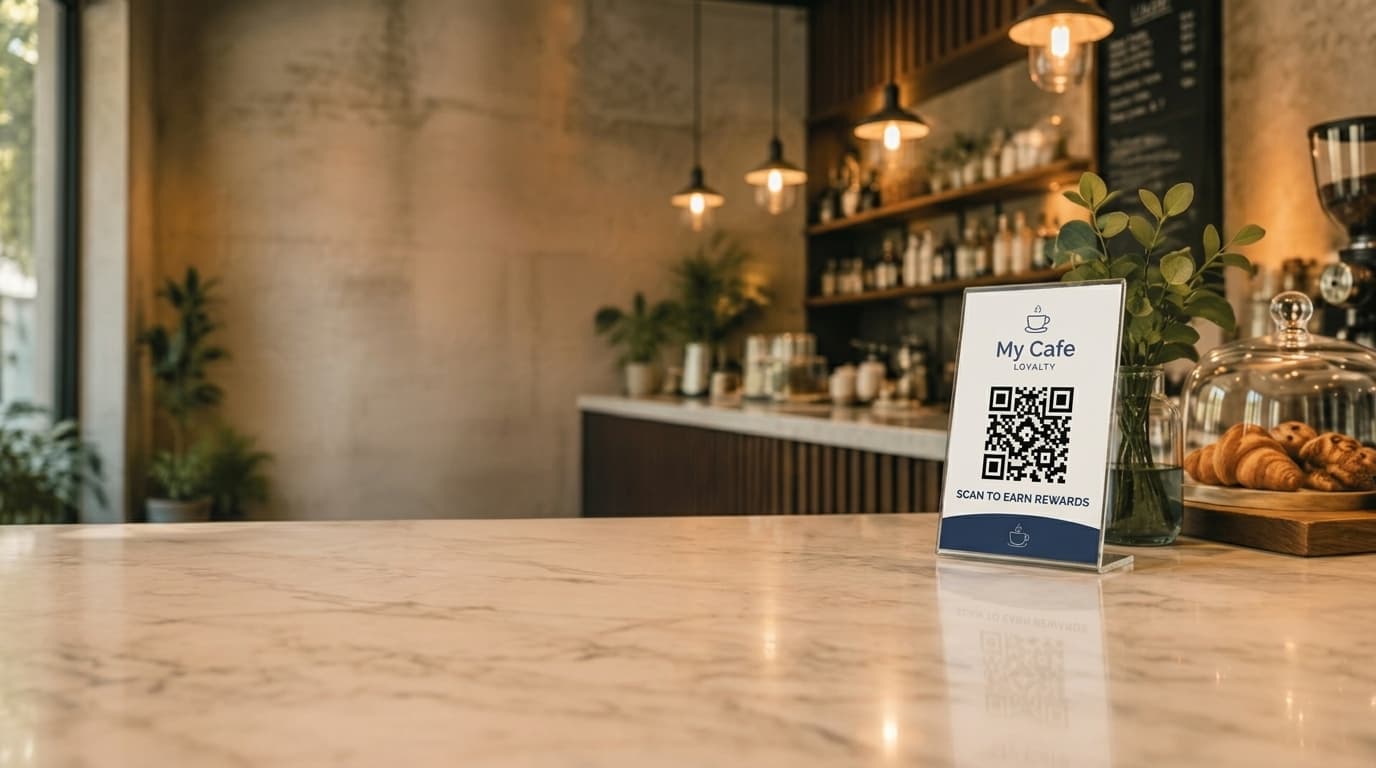
You do not need a marketing campaign, you need the code to be somewhere customers are already looking. Put it at the till, on tables, and near the pickup counter. A sign that says what the reward is ("Scan, check in, 11th coffee free") does more work than a bare QR code with no explanation.
For the first few weeks, have staff mention it verbally when they hand over a drink to a customer who looks like a regular. A quick "have you scanned our loyalty code yet?" converts far more customers than signage alone, because it removes the moment of uncertainty about whether it is worth bothering with.
6. Measure What Is Working
Once the program has been running a few weeks, check three numbers: how many customers have enrolled, how often enrolled customers are coming back, and how many rewards have actually been redeemed. If enrolments are healthy but redemptions are rare, your threshold might be too high, or awareness of the reward might be lower than you think.
You do not need deep analytics for this. A dashboard that shows new customers, repeat visit patterns, and rewards given out is enough to tell you whether the program is changing behaviour or just sitting there unused. Check in on it monthly rather than daily, loyalty behaviour shifts slowly, and daily numbers will mostly show you noise.
7. Keep Customers Coming Back
A visit-based reward on its own will carry you a long way, but once it is running reliably, a few automated touches add real goodwill without adding staff workload. A welcome message on a customer's first check-in confirms enrolment worked and sets expectations. An anniversary message with a small treat attached costs one item and generally reads as thoughtful rather than transactional. A win-back message to a regular who has gone quiet targets someone who already liked your cafe enough to visit repeatedly, rather than trying to convince a stranger.
None of these need to be done by hand, and realistically, past a handful of regulars, they will not get done reliably by hand. On My Cafe Loyalty, SMS features including welcome and anniversary messages are available from the Professional plan, and win-back campaigns alongside automated Google review requests are available on the Business plan. Every message only goes to customers who have opted in.
Sequencing tip: get the core visit-based reward and QR check-in solid first. Add welcome and anniversary messages once that is stable, then win-back and review requests once you have enough customer history for them to be worth automating.
What You Need to Get Started
My Cafe Loyalty runs on three plans, all with unlimited customers and a 30-day free trial where nothing is charged for the first 30 days: Starter ($49/month), Professional ($79/month), and Business ($169/month). QR check-in and visit-based rewards are included on every plan. SMS, including welcome and anniversary messages, requires Professional or above. Win-back campaigns and automated Google review requests require Business. It runs alongside whatever point-of-sale system you already use, there is nothing to integrate before you start.
One check-in per customer every 12 hours is enforced by default, so a single visit cannot be scanned twice to speed up the reward. Redemption is confirmed by staff looking the customer up, not a code the customer shows you.
Ready to set it up?
Start a 30-day free trial, no charge for 30 days, and have your QR code ready to put on the counter the same day.
Get Started FreeFrequently Asked Questions
How much does it cost to start a cafe loyalty program?
It depends on the approach. A paper punch card costs almost nothing but relies entirely on manual tracking. A dedicated platform like My Cafe Loyalty starts at $49/month (Starter plan) with a 30-day free trial and nothing charged during the trial, and unlimited customers on every plan. SMS features start on the $79/month Professional plan.
How much does it cost to start a cafe loyalty program?
It depends on the approach. A paper punch card costs almost nothing but relies entirely on manual tracking. A dedicated platform like My Cafe Loyalty starts at $49/month (Starter plan) with a 30-day free trial and nothing charged during the trial, and unlimited customers on every plan. SMS features start on the $79/month Professional plan.
Do I need an app to start a cafe loyalty program?
No. A branded app is the highest-effort option and is rarely worth it for an independent cafe, since most customers will not download an app for a handful of visits a month. A no-app QR code check-in gets you the same tracking without asking customers to install anything: they scan a code, enter their name and mobile number once, and check in in seconds on every visit after that.
Do I need an app to start a cafe loyalty program?
No. A branded app is the highest-effort option and is rarely worth it for an independent cafe, since most customers will not download an app for a handful of visits a month. A no-app QR code check-in gets you the same tracking without asking customers to install anything: they scan a code, enter their name and mobile number once, and check in in seconds on every visit after that.
How many visits should a loyalty reward require?
Ten visits is the most common default and matches what most customers already expect from a punch card. It is a reasonable starting point, but it should be adjustable to your margins and how often your regulars actually come in. A cafe with high-frequency regulars might lower it; a cafe with a higher average spend per visit might raise it.
How many visits should a loyalty reward require?
Ten visits is the most common default and matches what most customers already expect from a punch card. It is a reasonable starting point, but it should be adjustable to your margins and how often your regulars actually come in. A cafe with high-frequency regulars might lower it; a cafe with a higher average spend per visit might raise it.
How does reward redemption get verified at the counter?
The staff member looks the customer up in the system and confirms the redemption themselves, rather than relying on a code or a screenshot the customer could reuse or share. This keeps the reward meaningful and the counter interaction simple, without an extra step the customer has to manage.
How does reward redemption get verified at the counter?
The staff member looks the customer up in the system and confirms the redemption themselves, rather than relying on a code or a screenshot the customer could reuse or share. This keeps the reward meaningful and the counter interaction simple, without an extra step the customer has to manage.
Will a loyalty program work with my existing POS?
Yes. A QR-code loyalty platform like My Cafe Loyalty runs independently of your point-of-sale system, so it works alongside whatever POS you already use. There is nothing to integrate before you can start: staff check customers in on a phone or tablet at the counter, separate from however you take payment.
Will a loyalty program work with my existing POS?
Yes. A QR-code loyalty platform like My Cafe Loyalty runs independently of your point-of-sale system, so it works alongside whatever POS you already use. There is nothing to integrate before you can start: staff check customers in on a phone or tablet at the counter, separate from however you take payment.