Search "loyalty program ideas for cafes" and you will find lists of twenty or thirty tactics, most of them variations on the same handful of ideas dressed up differently. Independent cafes do not need more ideas. They need to know which few actually move the needle, and which ones sound clever but quietly cost more staff time than they are worth.
This is a practical list, not an exhaustive one. Each idea below includes what it is, why it works, and an honest read on the effort involved, including which parts a loyalty platform can automate for you and which parts still depend on your team.
1. Visit-Based Rewards (The Classic, Done Digitally)
Buy 10 coffees, get the 11th free. It is the format every customer already understands, and that familiarity is the entire point: there is nothing to explain at the counter and nothing for a customer to misread. The only real weakness of the paper version is that punch cards get lost, forgotten at home, or left in a jacket pocket, and a lost card usually means a lost customer.
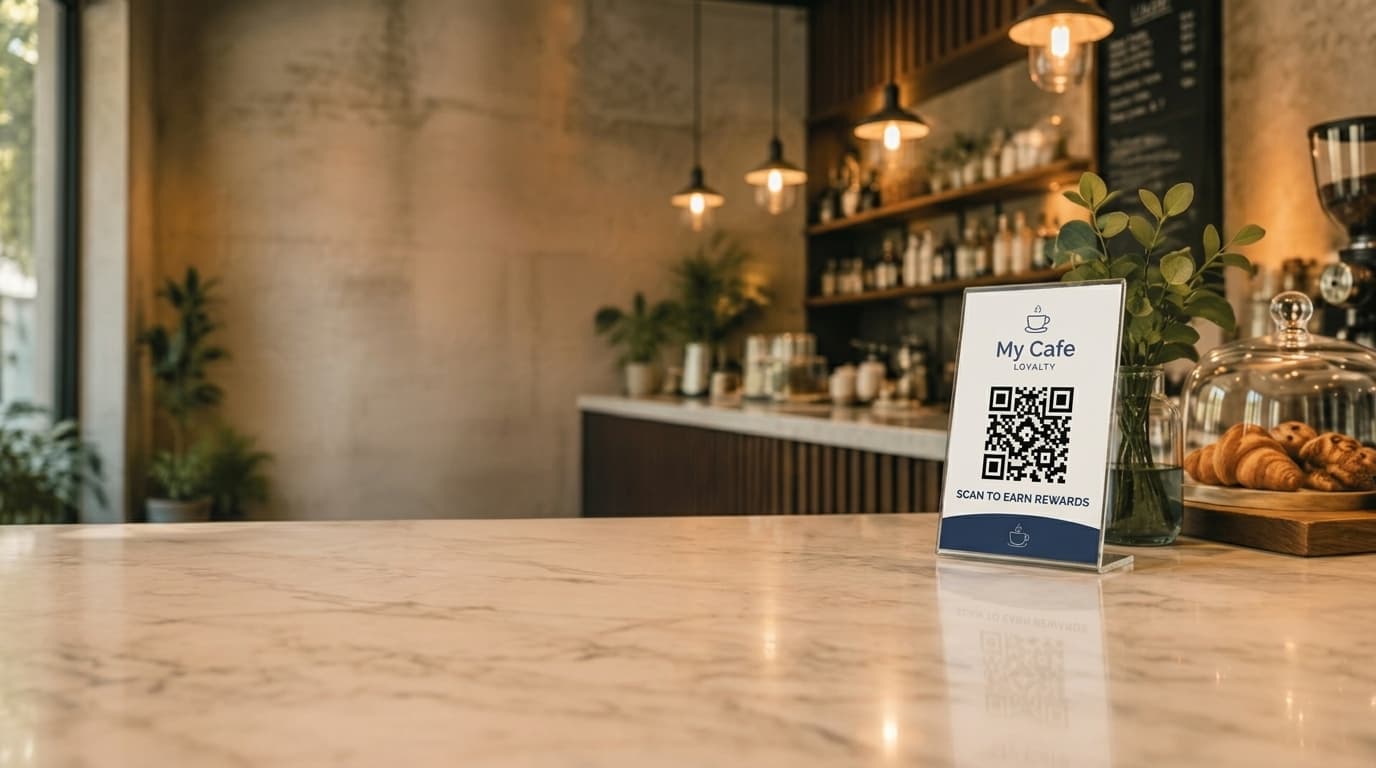
A QR-code version fixes the fragility without changing the format customers already trust. The customer scans a code at the till, enters their name and mobile number once (about 30 seconds), and every visit after that is a scan that takes seconds. There is no app to download and nothing to carry. My Cafe Loyalty defaults to a reward after 10 visits, but that threshold is configurable per cafe, so you can tune it to your margins and how often your regulars realistically come in.
Redemption is deliberately low-friction on the customer side and controlled on the staff side: staff look the customer up and confirm the redemption themselves, rather than a customer showing a code or a screenshot. That keeps the reward meaningful without adding a fraud-prone extra step to the counter interaction. A built-in rate limit (one check-in per 12 hours per customer) stops someone from scanning twice on the same visit to speed-run the reward.
Effort: Low to set up, effectively zero ongoing effort once it is running. This is the foundation every other idea on this list sits on top of.
2. A Welcome Moment on First Visit
The first check-in is the best moment you will get to set expectations. A short, automatic welcome message confirming the customer is enrolled and explaining how the reward works costs you nothing extra to send once SMS is switched on, and it answers the question every new customer has ("did that actually work?") without needing a staff member to explain it.
This is one of the easiest ideas to automate because the trigger is unambiguous: a first-ever check-in. SMS is available from the Professional plan and only ever goes to customers who opted in, so there is no need to weigh this one against a privacy cost.
3. Birthday Rewards
A birthday message with a small treat attached (a free pastry, a size upgrade) is one of the highest-goodwill, lowest-cost ideas on this list. It costs you one item, it is not tied to spend, and customers generally read it as genuinely thoughtful rather than transactional, because it is not asking for anything in return.
The catch is that it depends on collecting a date of birth, which is one more field customers have to hand over, and it only works if the message actually goes out on the day, every time, which is not realistic to track by hand once you have more than a handful of regulars. My Cafe Loyalty does not collect dates of birth, so a true birthday message would be a manual job. What it does automate is an anniversary message on the anniversary of a customer's first visit (Professional plan and up, sent only to customers who opted in) — the same once-a-year personal touch, triggered reliably without anyone needing to remember or ask for a birth date.
4. Win-Back Offers for Lapsed Regulars
Every cafe has customers who used to come in twice a week and quietly stopped. Most of the time nobody notices until months later, because there is no natural moment where a staff member sees the gap. A win-back message, sent when a previously regular customer has gone unusually quiet, is one of the more underrated ideas here because it targets people who already liked your cafe enough to visit repeatedly, rather than trying to convince strangers.
Doing this manually means someone reviewing visit history and remembering who used to come in often, which does not scale past a very small customer base. It is a genuinely good fit for automation because "gone quiet relative to their own pattern" is exactly the kind of thing software is better at noticing than a person glancing at a customer list. Win-back campaigns are available on the Business plan, built on customer segments (for example, customers who have not visited in a set number of days), sent only to customers who opted in to marketing SMS.
Effort: High to do well by hand, low once automated. This is the clearest case of software doing something a solo owner realistically will not keep up with on their own.
5. Tiers and VIP Recognition
Formal tiers (bronze/silver/gold, or a named "regulars club") work well for larger loyalty operations, but for most independent cafes the honest answer is that a full multi-tier structure is more complexity than the customer base justifies. What does work at cafe scale is simpler: knowing who your most frequent, longest-standing customers are, and occasionally treating them like it.
A loyalty platform can do the identification for you by tracking visit frequency and classifying customers by engagement (new, active, loyal, and so on), and on the Business plan that classification can be turned into a targeted segment for a one-off SMS or offer. What it will not do is the actual recognition, a barista remembering a regular's order or a genuine "good to see you again" is still a human job, and arguably the part that matters most.
6. Referral Incentives
"Bring a friend, you both get a coffee" is a reasonable idea in principle, word of mouth is still how most independent cafes get their best customers, but it is worth being realistic about it. Tracking who referred whom without dedicated referral-code infrastructure usually comes down to an honesty system at the counter ("tell the barista who sent you"), which works fine at a small scale and gets messy once a cafe has more than a few regulars running it.
If you run this, keep it simple and low-stakes: a free add-on rather than a full free drink, and a clear, short window rather than an open-ended offer. Treat it as a goodwill gesture that occasionally pays for itself, not a growth channel you can measure precisely.
7. Off-Peak Incentives
If your 7-9am rush is already at capacity but your 2-4pm slot is dead, a loyalty program is a reasonable lever to shift some demand, for example, double visit-credit for check-ins in a quiet window, or a small discount that only applies outside peak hours. This does not need special software support: it is a pricing and rostering decision you make and communicate at the counter or on a sign, independent of whatever check-in system you run.
The honest caveat is that this only works if your quiet period is genuinely quiet because of low foot traffic, not because your quiet period is quiet for a good reason (the office crowd has already gone back to work). Test it for a few weeks before assuming it will move anything.
8. Google Review Nudges at the Right Moment
Not strictly a loyalty reward, but it belongs on this list because it uses the same infrastructure and the same principle: ask at the right moment, not randomly. A customer who has visited several times and earned a reward has shown you they like the place; that is a far better moment to ask for a Google review than a cold ask to a first-time visitor.
Doing this well means never gating the review (asking only happy customers to leave a public review while routing complaints elsewhere is against Google's policies) and never incentivising the review itself. Automated, milestone-based review requests that offer both a public review option and a private feedback option are available on the Business plan, sent only to customers who have opted in.
Where to Start
You do not need to run all eight at once, and trying to would spread a small team thin for little extra return. A sensible order for most independent cafes:
Get the visit-based reward running first
Everything else on this list assumes you already have a reliable way to track visits. QR check-in gives you that foundation, plus the customer data every other idea depends on.
Turn on welcome and reward-ready messages
Both are fully automatic, opted-in, and require no ongoing decisions from you once configured.
Turn on anniversary messages for each customer's first-visit anniversary
Low effort, high goodwill, and it runs itself in the background.
Layer in win-back and review requests as you grow
These earn their keep once you have enough customer history for segments and milestones to mean something.
Keep VIP recognition and referrals as human, judgement-based extras
Use the data to decide who deserves the gesture; leave the gesture itself to your team.
Start with the foundation, add the rest as you go
QR check-in and visit-based rewards are included on every plan; automated SMS (welcome, reward and anniversary messages) is on Professional and Business, and win-back and Google review automation are on Business. A 30-day free trial, nothing charged for 30 days.
Get Started FreeWhat You Need for Each Idea
My Cafe Loyalty runs on three plans, all with unlimited customers and a 30-day trial: Starter ($49/month), Professional ($79/month), and Business ($169/month). Visit-based rewards and QR check-in are available on every plan. SMS (including welcome and anniversary messages) requires Professional or above. Win-back campaigns and automated Google review requests require Business.
None of this requires customers to install anything. Every idea above runs through the same QR check-in your customers already use, so adding a new idea later does not mean asking customers to do anything differently.
Frequently Asked Questions
What is the simplest loyalty program idea for a cafe?
The classic buy-10-get-1-free visit-based reward is still the simplest and most understood format. Customers get it instantly, there is nothing to explain, and it rewards the behaviour you actually want: repeat visits. A digital version replaces the paper punch card with a QR code check-in, so there is nothing to lose or forget.
What is the simplest loyalty program idea for a cafe?
The classic buy-10-get-1-free visit-based reward is still the simplest and most understood format. Customers get it instantly, there is nothing to explain, and it rewards the behaviour you actually want: repeat visits. A digital version replaces the paper punch card with a QR code check-in, so there is nothing to lose or forget.
Do cafe loyalty programs need an app to work?
No. Most independent cafes are better served by a QR-code check-in than a branded app. Customers scan a code at the counter, enter their name and mobile number once, and check in at every future visit in seconds, no download, no login. An app adds real cost and maintenance for a business that gets a handful of visits per customer per month.
Do cafe loyalty programs need an app to work?
No. Most independent cafes are better served by a QR-code check-in than a branded app. Customers scan a code at the counter, enter their name and mobile number once, and check in at every future visit in seconds, no download, no login. An app adds real cost and maintenance for a business that gets a handful of visits per customer per month.
Which loyalty program ideas are easiest to automate?
Anything triggered by a specific, detectable event is easy to automate: welcome messages on first visit, reward-ready alerts when a customer hits the visit threshold, anniversary messages on the anniversary of a first visit, and win-back messages to customers who have gone quiet. Ideas that depend on judgement calls, like VIP recognition or referral incentives, take more manual effort from staff even with software support.
Which loyalty program ideas are easiest to automate?
Anything triggered by a specific, detectable event is easy to automate: welcome messages on first visit, reward-ready alerts when a customer hits the visit threshold, anniversary messages on the anniversary of a first visit, and win-back messages to customers who have gone quiet. Ideas that depend on judgement calls, like VIP recognition or referral incentives, take more manual effort from staff even with software support.
How many visits should a cafe require before a reward?
Ten visits is the most common default and matches what most customers already expect from a punch card. It is a reasonable starting point, but it should be adjustable. A cafe with a small, high-frequency regular base might lower it; a cafe with a higher average spend per visit might raise it. The right number depends on your margins and how often customers realistically visit.
How many visits should a cafe require before a reward?
Ten visits is the most common default and matches what most customers already expect from a punch card. It is a reasonable starting point, but it should be adjustable. A cafe with a small, high-frequency regular base might lower it; a cafe with a higher average spend per visit might raise it. The right number depends on your margins and how often customers realistically visit.